A paper-feeling, AI-driven book about you, for navigating a hiring system that is exhausting humans.
In The Diamond Age, the artifact at the center of the story is a book. A Young Lady's Illustrated Primer is nanotechnology made to look and feel like paper, driven by an intelligence, and its whole purpose is to teach one reader who she is, in a world whose institutions have failed her.
I did not set out to build a Primer. I set out to combat an employment market where people send hundreds of resumes into an abyss. Before I built anything, I looked at my own resume. I gave it to Claude along with my code repos, my presentations, years of work. When it read everything I had really made, it told me I had undersold myself. Maybe it can go the other way: oversell and fail the interview. This tool is something that can read the evidence and mirror it back to you. And so, it's a Primer of sorts; you learn about yourself.
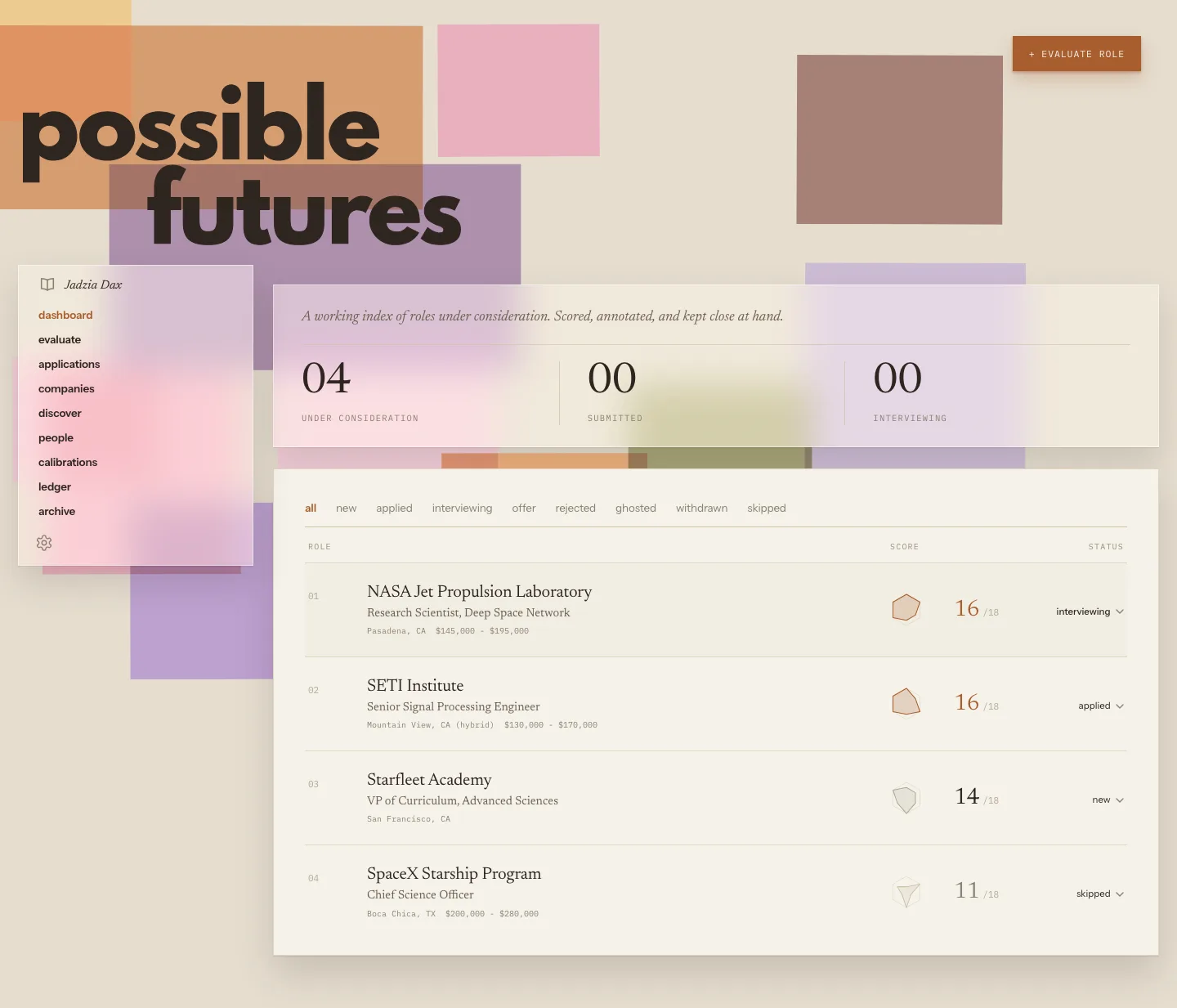
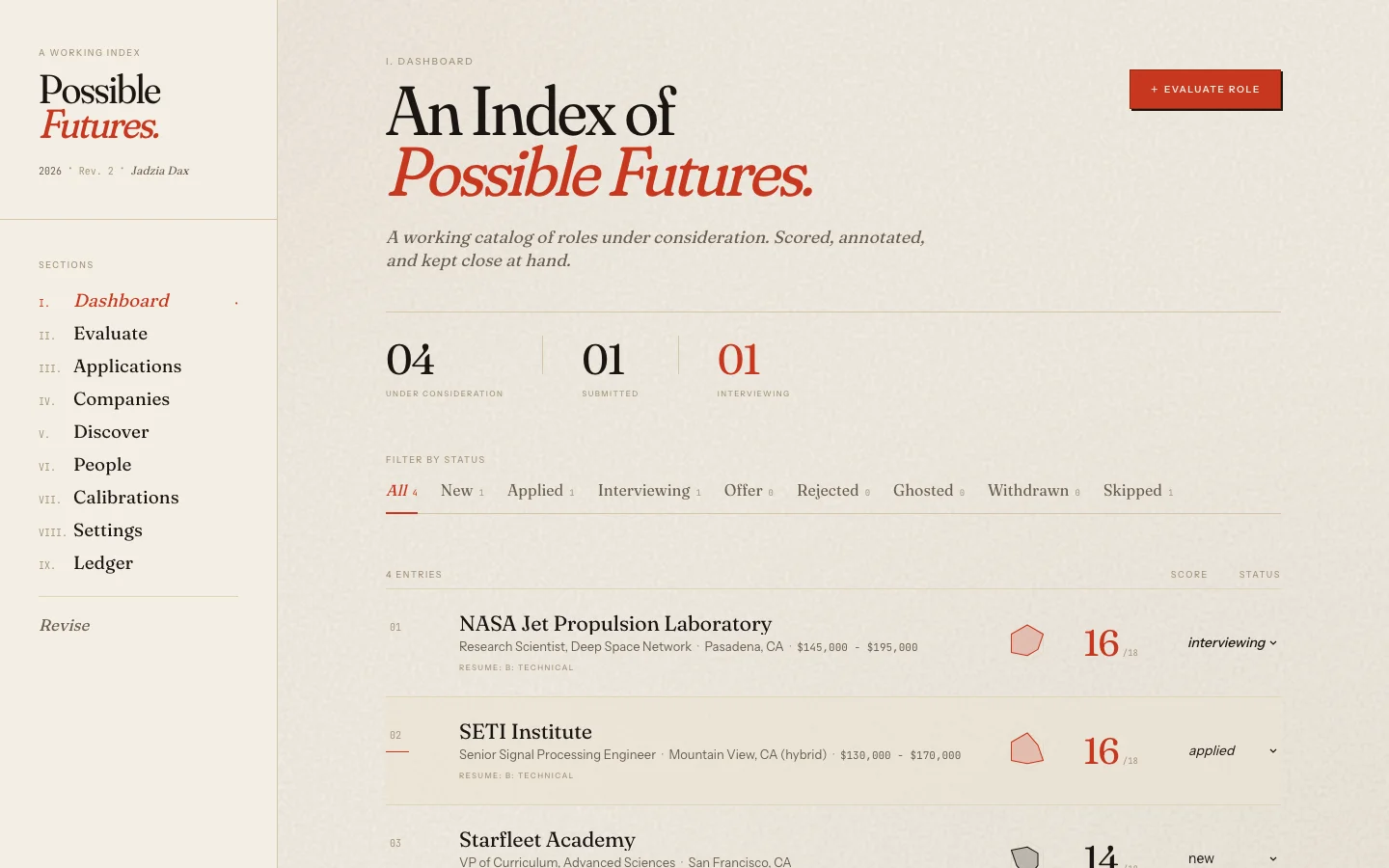
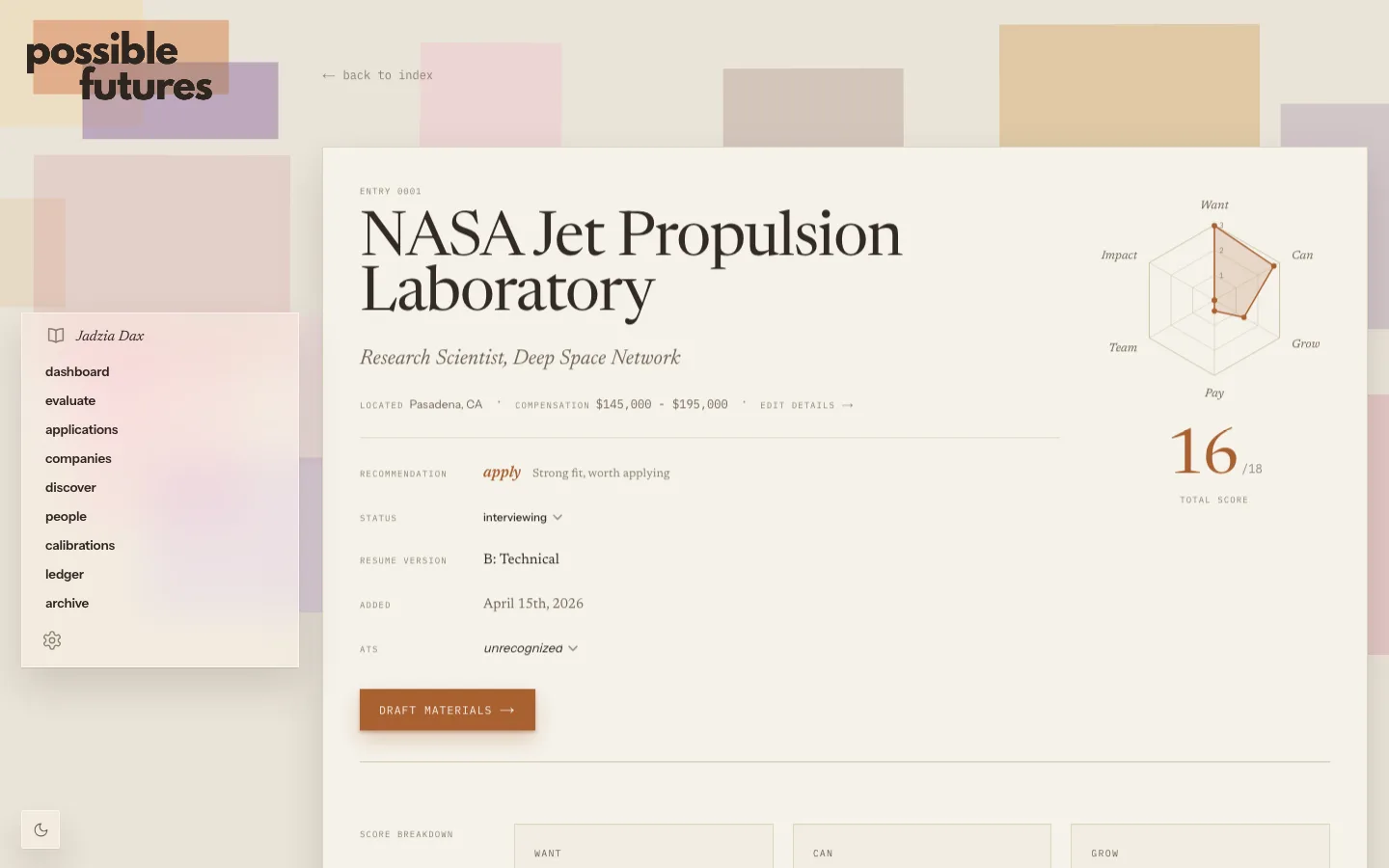
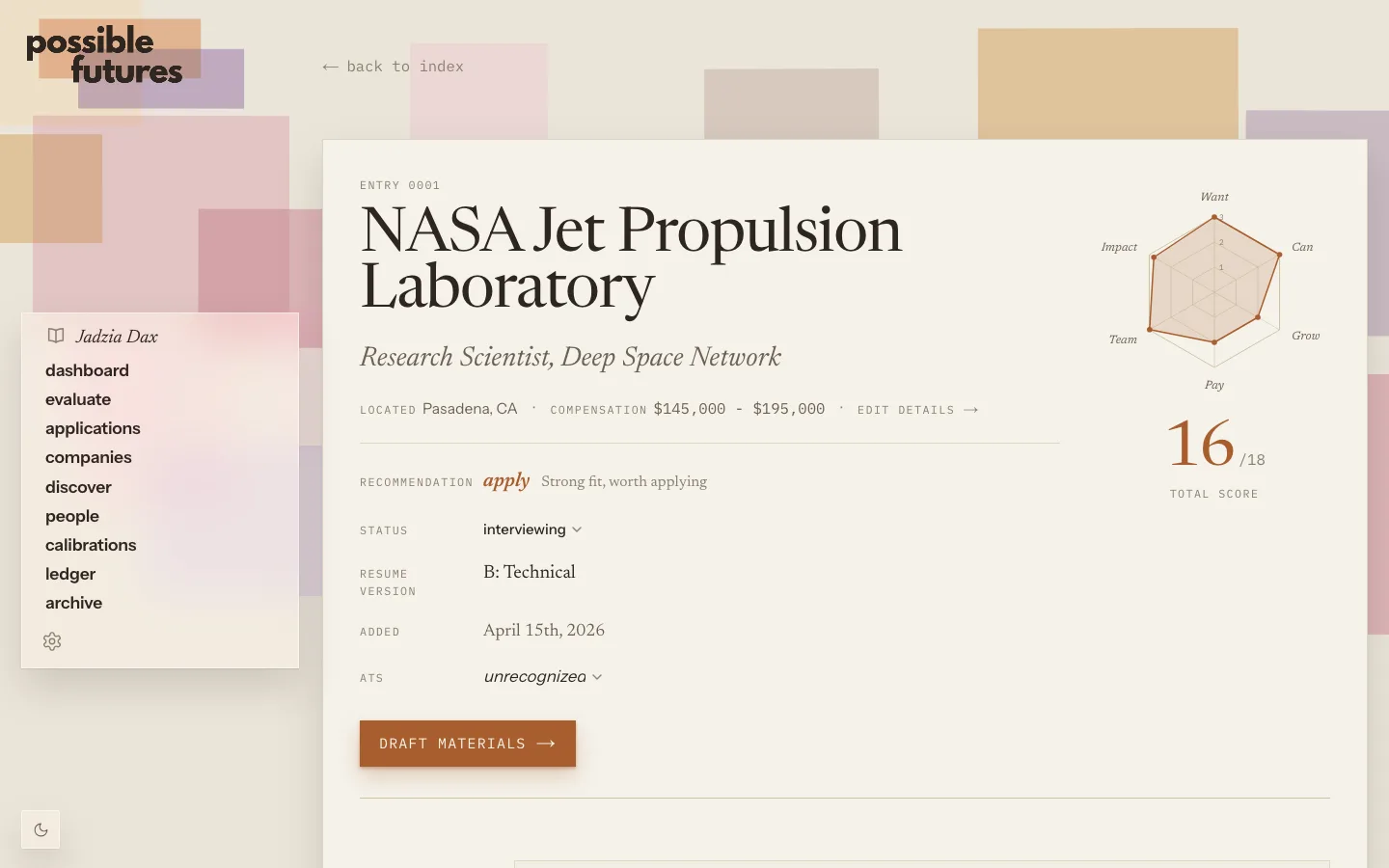
The dashboard. A working index of roles under consideration — scored, annotated, and kept close at hand.
01The problem
Hiring is mediated by machines only on one side.
I teach in a graduate interaction design program. Over the last couple of years I watched my students grow anxious about their futures, and I watched my own feed fill with layoffs. Hiring is increasingly mediated by AI on the company side. The people applying have no equivalent machinery on theirs, and the advice they get — apply to more things, optimize your keywords — asks them to become more machine-like to survive a machine.
I wanted the opposite: a tool that helps someone apply to fewer things, more deliberately, as themselves. And this is coming from someone who's spent the past decade trying to speak to machines.
02The bet
Anti-funnel.
Every funded tool in this space is a funnel: more applications, faster, with less friction. Possible Futures is anti-funnel. It is a working index of roles you are weighing, scored against your own compass, calibrated by you. The design premise is that a job search is really a question about the future, so the tool borrows from foresight practice rather than from sales pipelines.
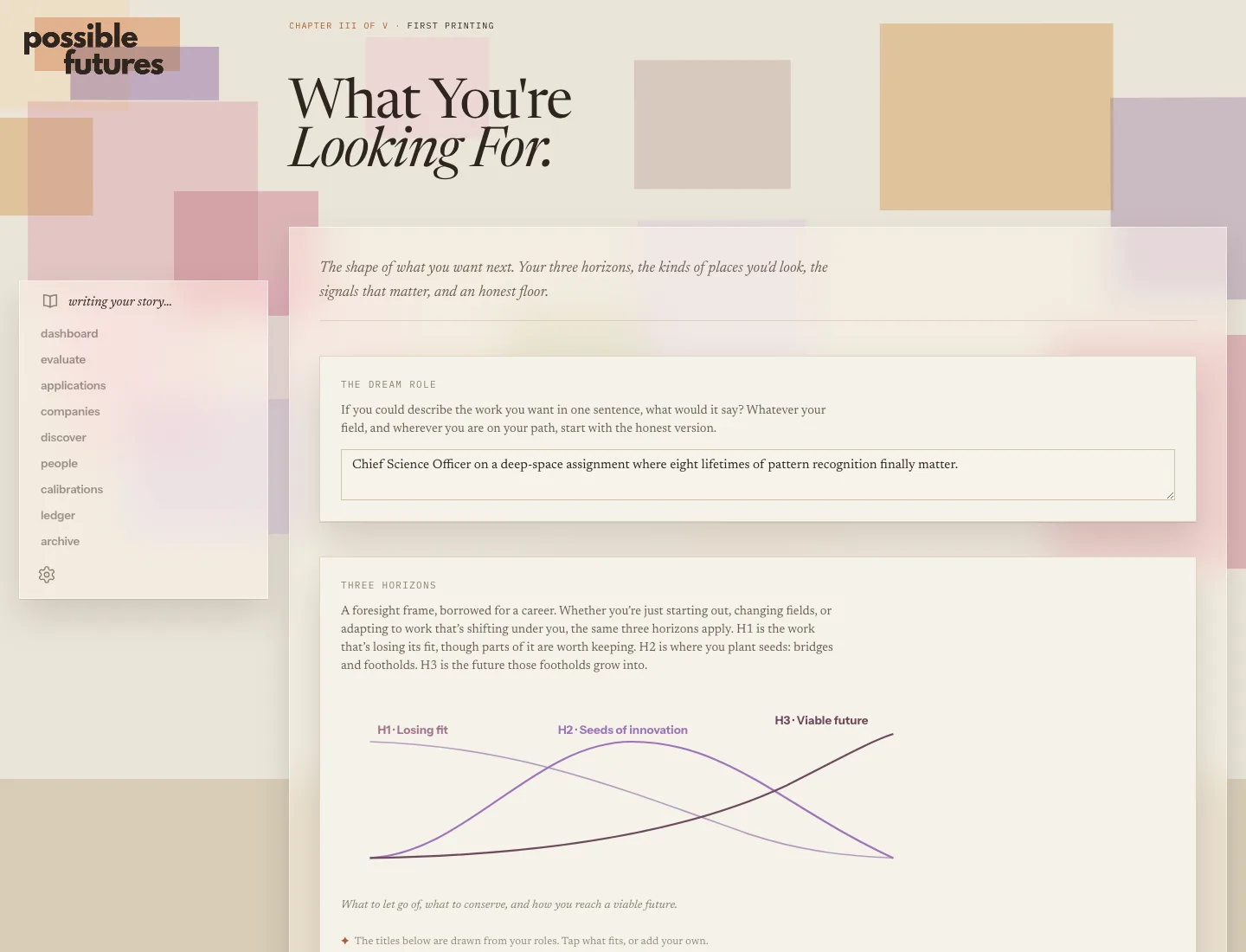
Three principles carried every decision. You write the foundation: no resume import, no LinkedIn scrape, because everything downstream runs on your voice. AI helps; it does not write. You approve suggestions only if they are real, and every score can be overruled. And say it plainly: the tool talks like a steady person, because a job search can cause real stress.
Writing the compass. The shape of what you want next — three horizons, the places you'd look, the signals that matter, and an honest floor.
03The mirror
It remembers what you said, and holds you to it.
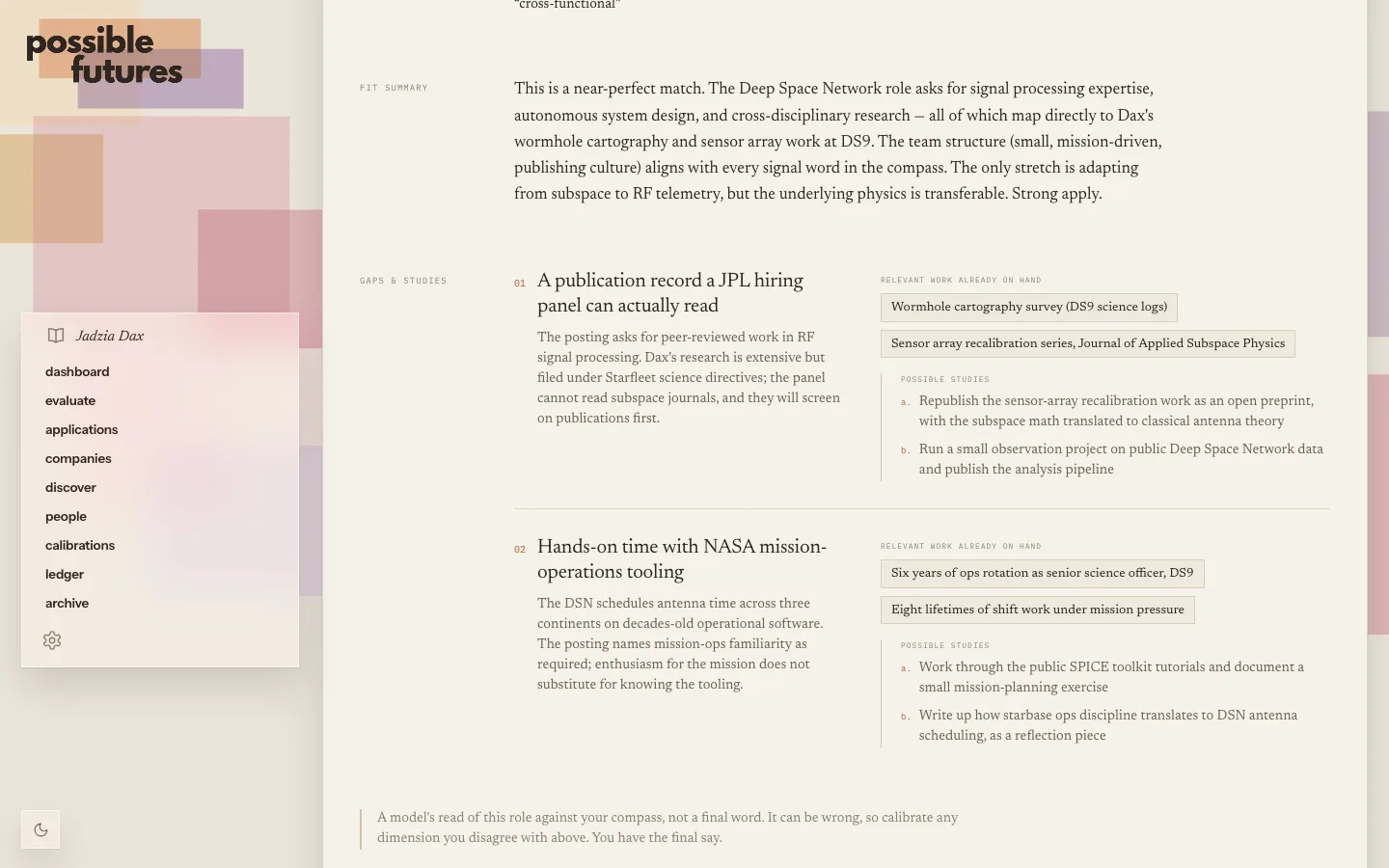
A job search under stress drifts. You start applying just to apply, and every posting begins to look like something you could talk yourself into. The fit summary exists for that moment. It reads a posting against what you said you wanted when you went through the ritual of writing it down, and reflects it back in plain prose: here is where this role meets your compass, here is where it does not, here is what you might be reaching for. The AI is not judging you against the market. It is remembering what you said, and holding you to it.
The fit summary. Signals, a plain-prose read, and the gaps grid below — where the role meets your compass, and where it doesn't.
The fit summary is where that first moment with Claude lives on in the product. It is where the tool pushes back, and the pushback runs in both directions. Sometimes it catches you reaching for a role you do not really want. Sometimes it catches your story underselling work you actually did, and the right response is not to correct the score but to go back and revise your Book.
“You learn about yourself. That loop, role by role, is the product.”
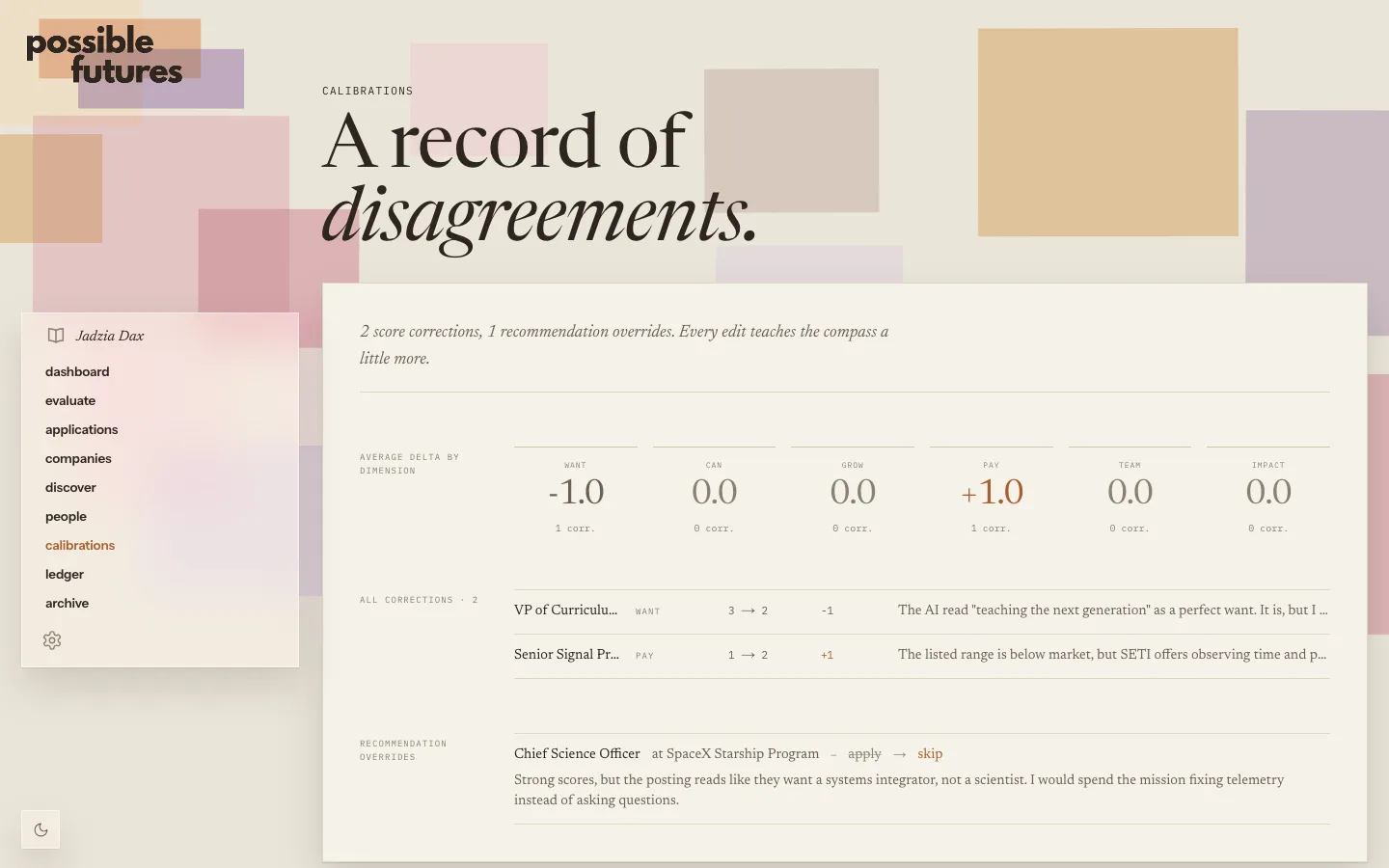
And because the mirror can be wrong, you can talk back. Every score can be corrected, every recommendation overruled, and each disagreement teaches the AI and shapes your compass. The calibrations page is titled “A record of disagreements” on purpose. The role page says it outright: a model's read, not a final word. You have the final say.
A record of disagreements. Two score corrections, one override — every edit teaches the compass a little more.
04The Book
Paper, not pipeline.
I wanted this to feel like paper. In The Diamond Age, matter compilers make anything for anyone, for nothing; the Neo-Victorian phyle signals what it values with handmades, real paper and real cotton. That stuck with me. In a world where generated material costs nothing, the scarce and human thing is the made thing. A tool about applying as yourself should feel like paper, not like a pipeline.
The first design pass took that literally: make it look like a book. I liked it.
Then I started noticing that everyone's projects looked like mine, because everyone is building with Claude, and Claude has a design sense. The book was beautiful and common. If the whole point is not sounding like everyone else's AI-written cover letter, the tool could not look like everyone else's AI-designed app.
⟷
V1V2
Drag to compare. V1 looked like a book: beautiful, and common. V2 kept the paper and let it be an app.
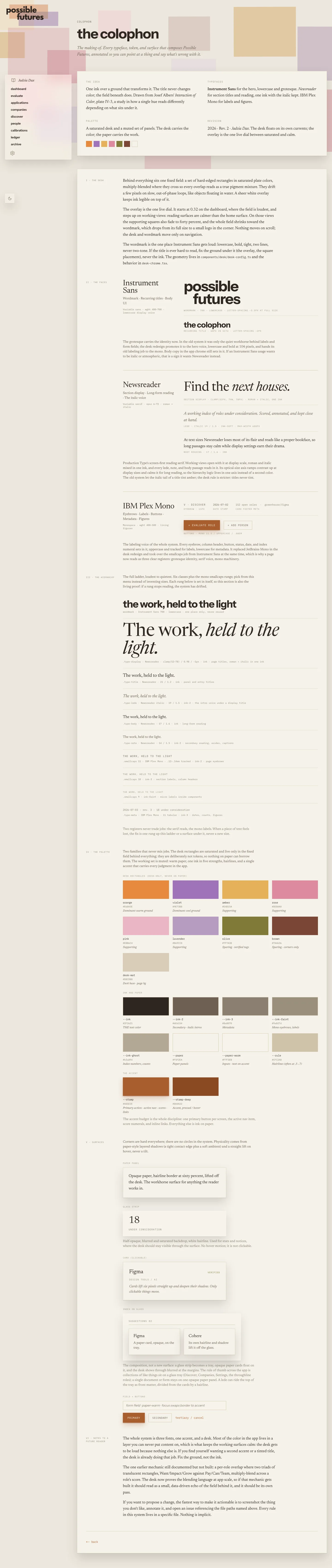
The second pass kept the paper and let it be an app. It combines two things that are actually mine: a long interest in Bauhaus — the field of translucent squares under everything is after Albers — and my day-to-day work at the time, building an interface over a large image viewer, panels of controls floating over a deep canvas. Work happens on paper laid over glass trays; the field is the canvas underneath. Serif reads, mono labels, sans operates. The app documents the system to itself on an in-app colophon.
The colophon. The system documenting itself — type ladder, palette, and the rules of the desk.
An honest note that stays in: this was one person moving fast with AI tools, and you can still see the AI artifacts coming through. I own that.
05The labs
The process moved quickly with exploration "labs".
This section is my journey of learning to work with these new AI tools.
Every contested design decision got a standalone lab: the real context rebuilt in a static page, five or six complete treatments over identical real data, a viewing protocol, and a pick with reasons. The AI proposes in complete alternatives; I choose, with taste and context the AI does not have. The labs live in the repository and still run.
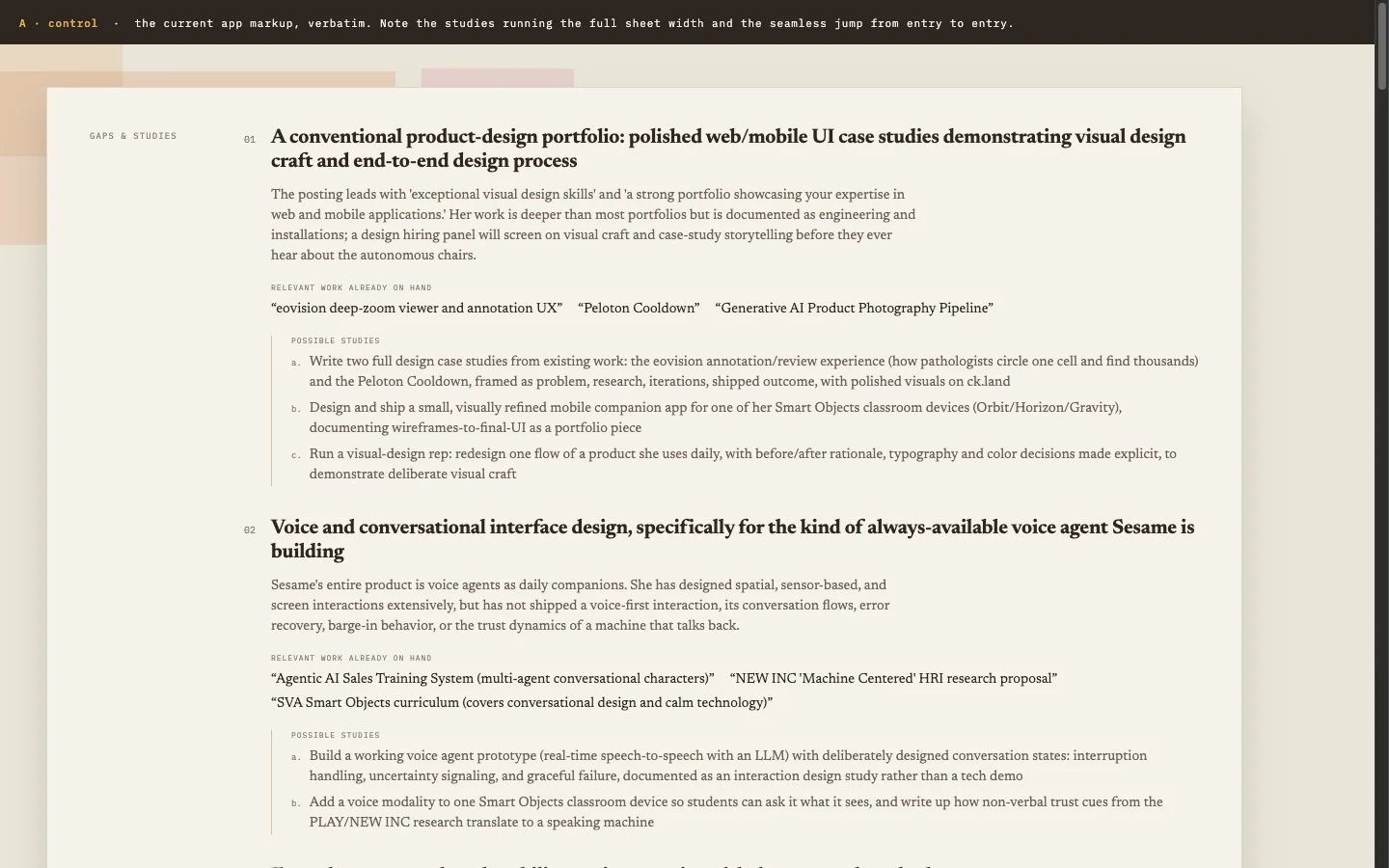
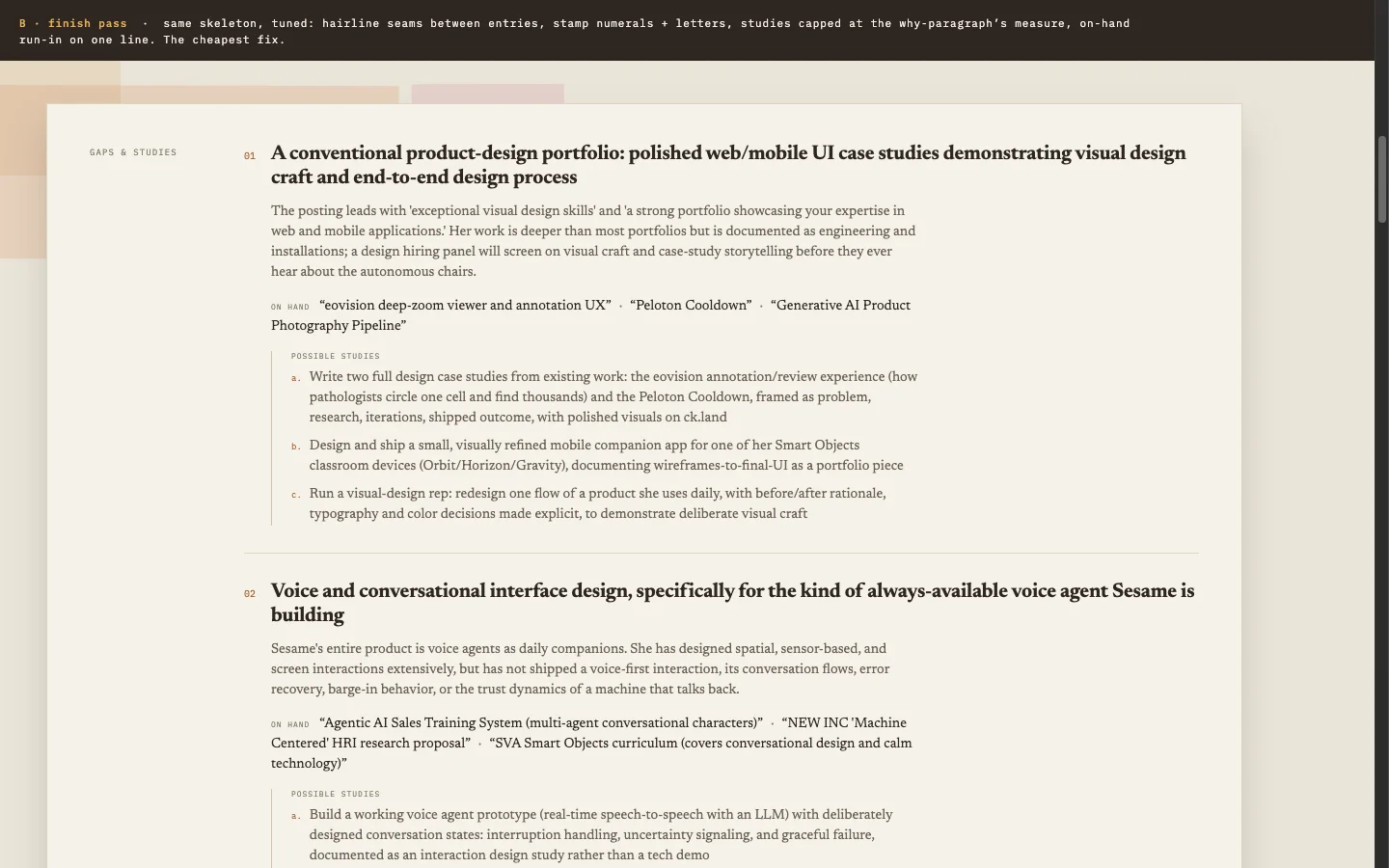
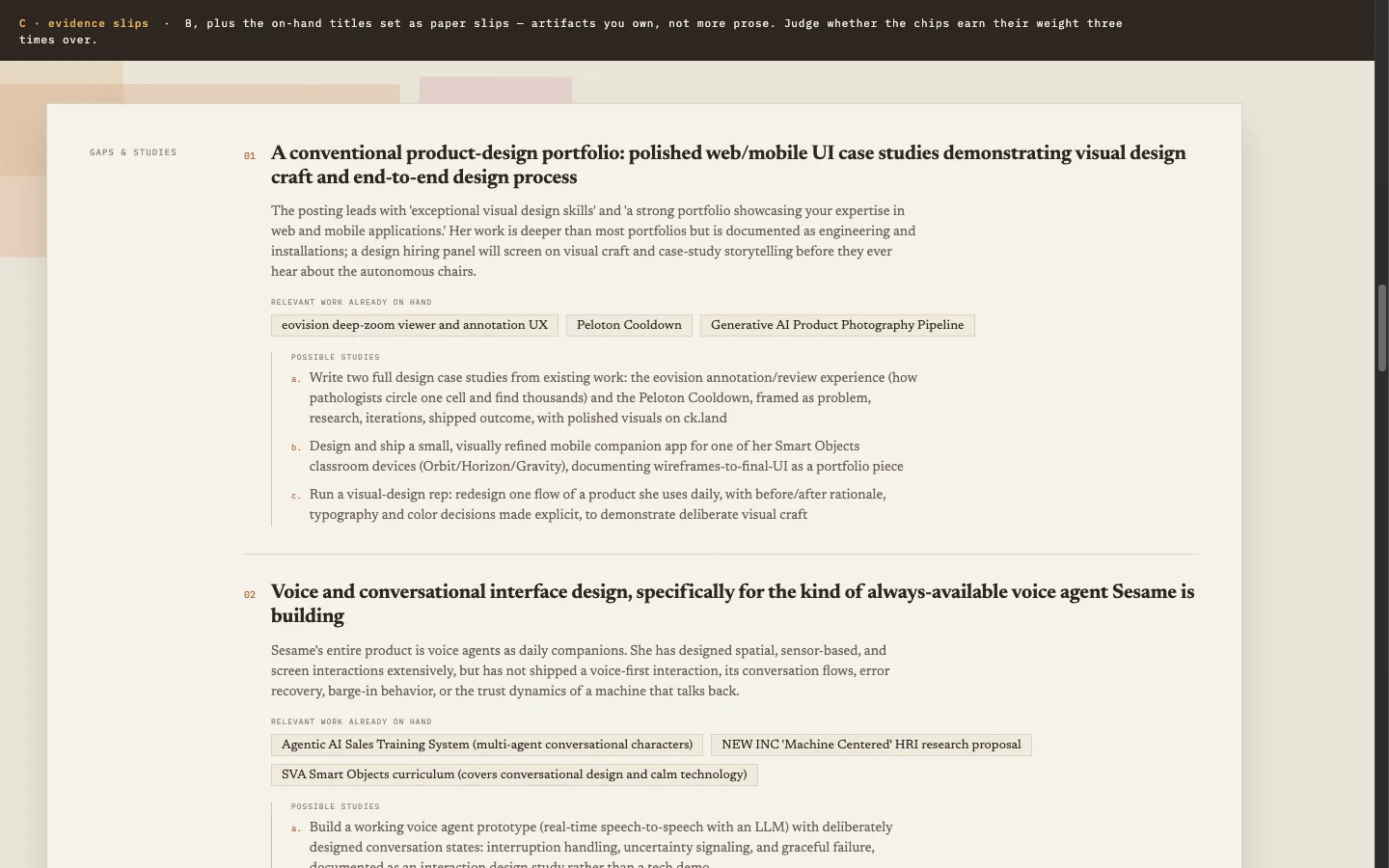
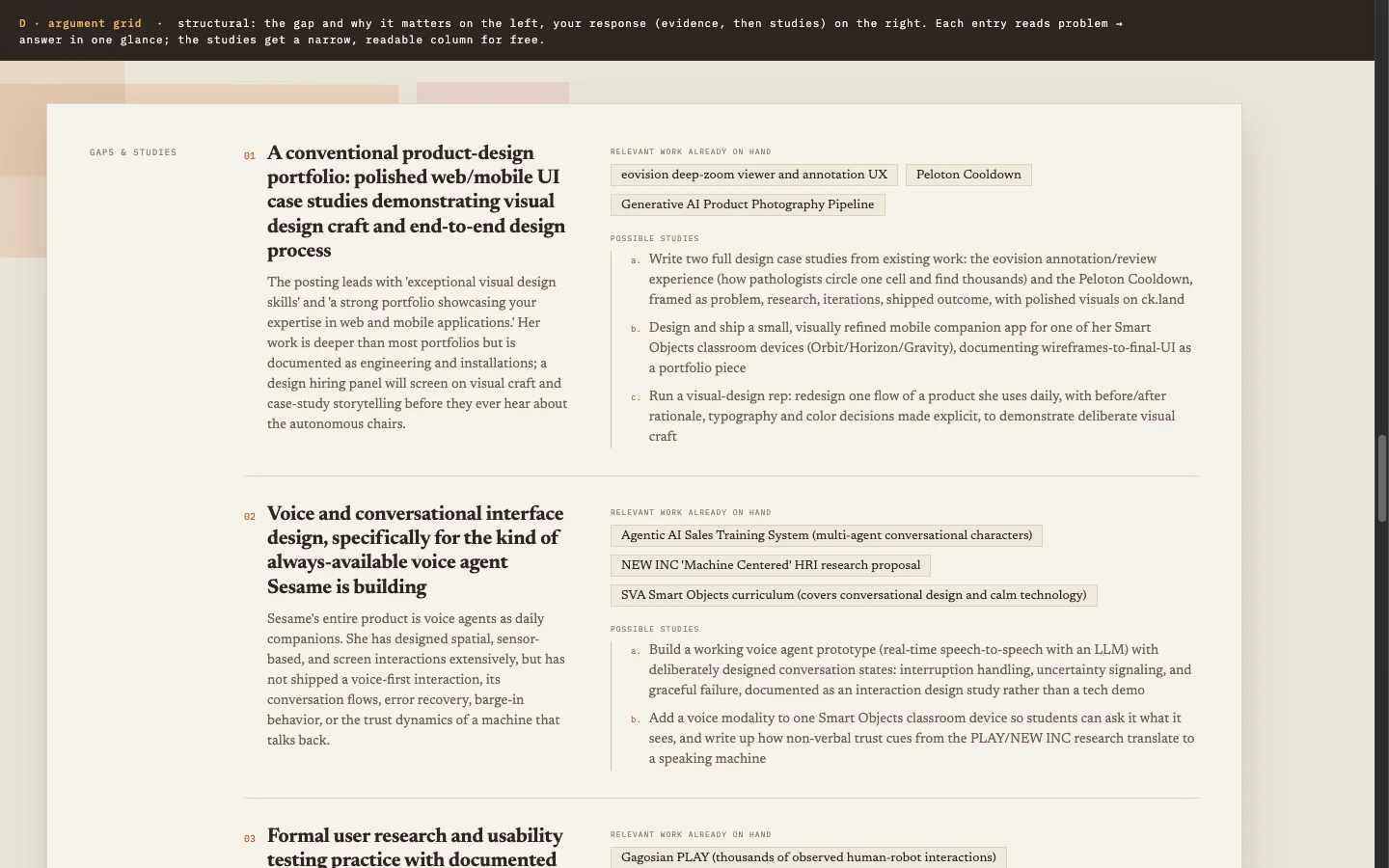
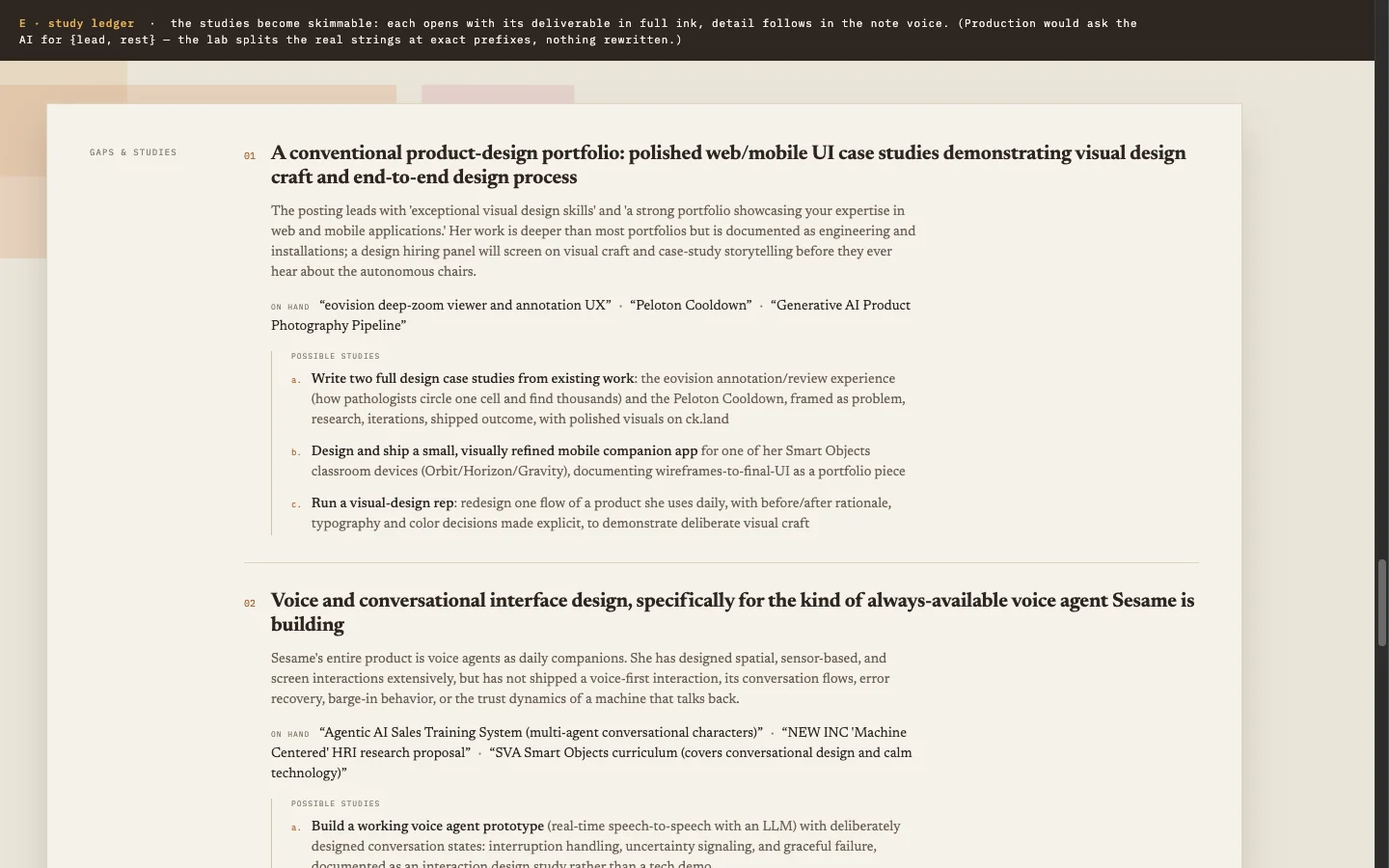
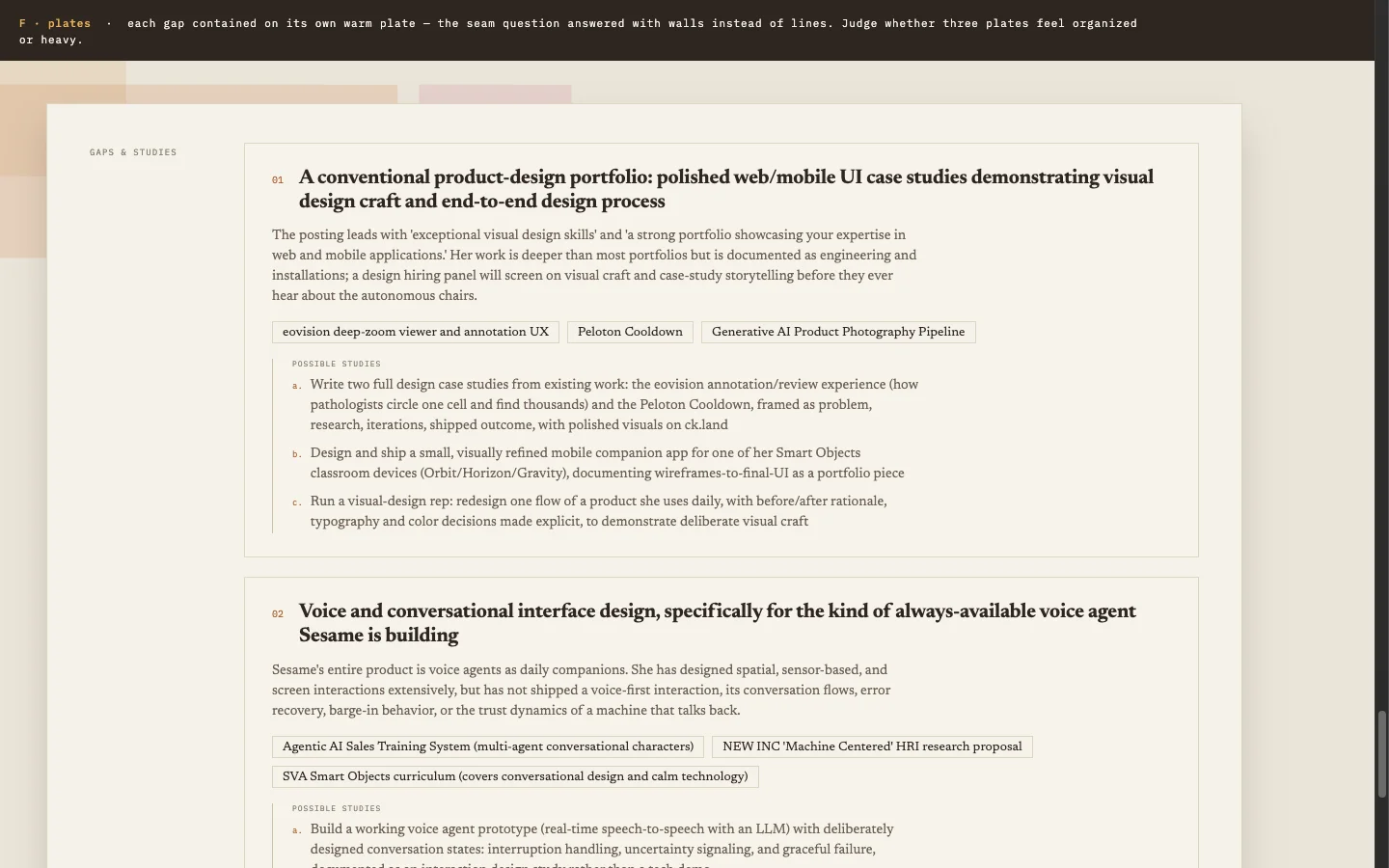
When the gap analysis suggestions text started to feel too long and unapproachable at first glance, it got a lab: six structures over the same real role, from the current layout as a control. I quickly picked one that felt more legible and shipped it in an hour. Is this the best way to design? Probably not, but it's fast.
The argument grid. Problem on the left, your response on the right. Shipped the same day.
E · Ledger
A ledger structure — tidy, but flattened the argument.
F · Plates
Paper plates, the most literal take on the desk metaphor.
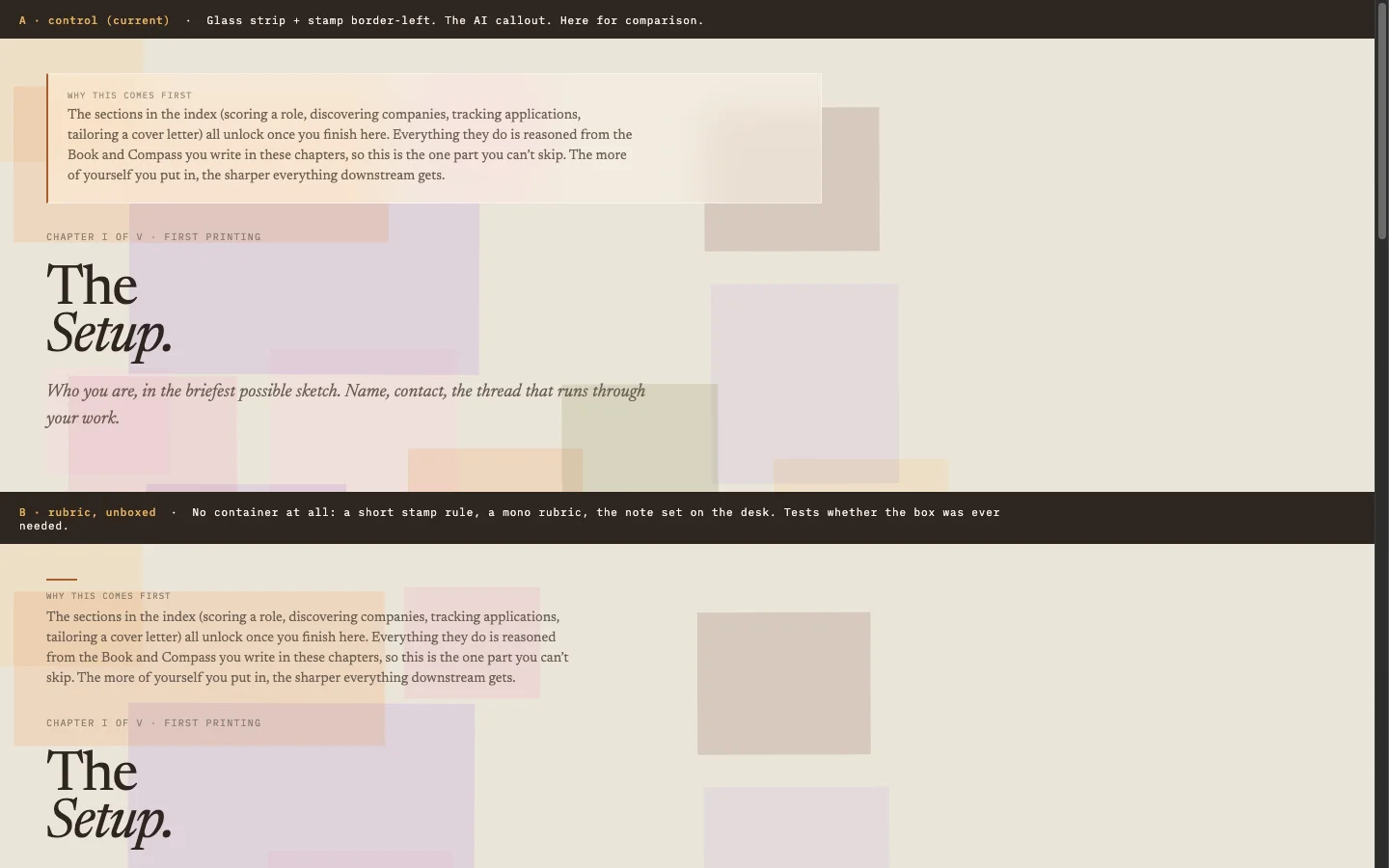
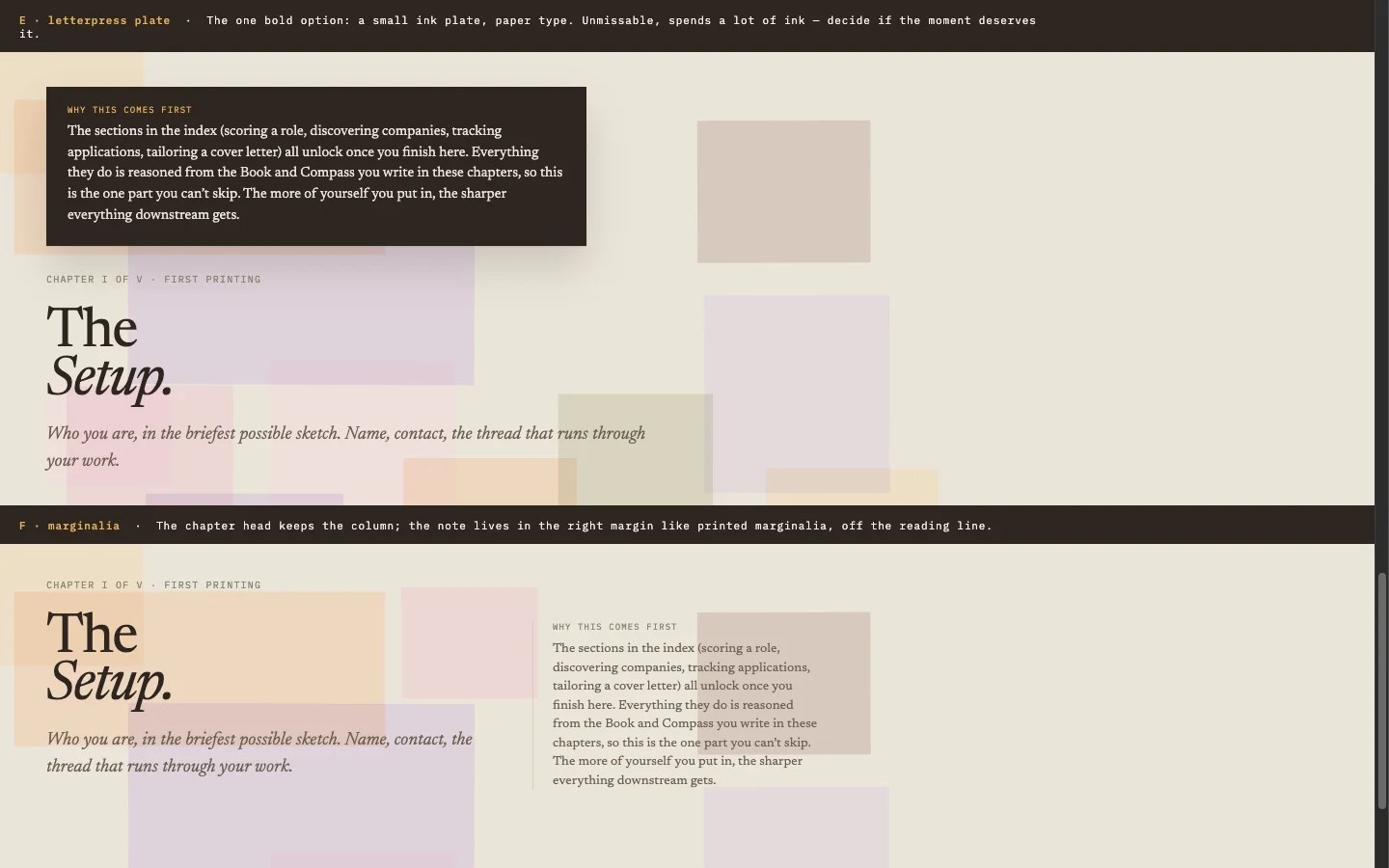
When quiet text kept drowning on the animated field, the legibility lab tried six mediations per surface. The picks became system rules: front matter moves onto the sheet, notices become letterpress plates, actions land on paper.
Before · control
The “why this comes first” notice, drowning on the animated field.
The pick · letterpress plate
Notices become letterpress plates — a system rule now, not a one-off fix.
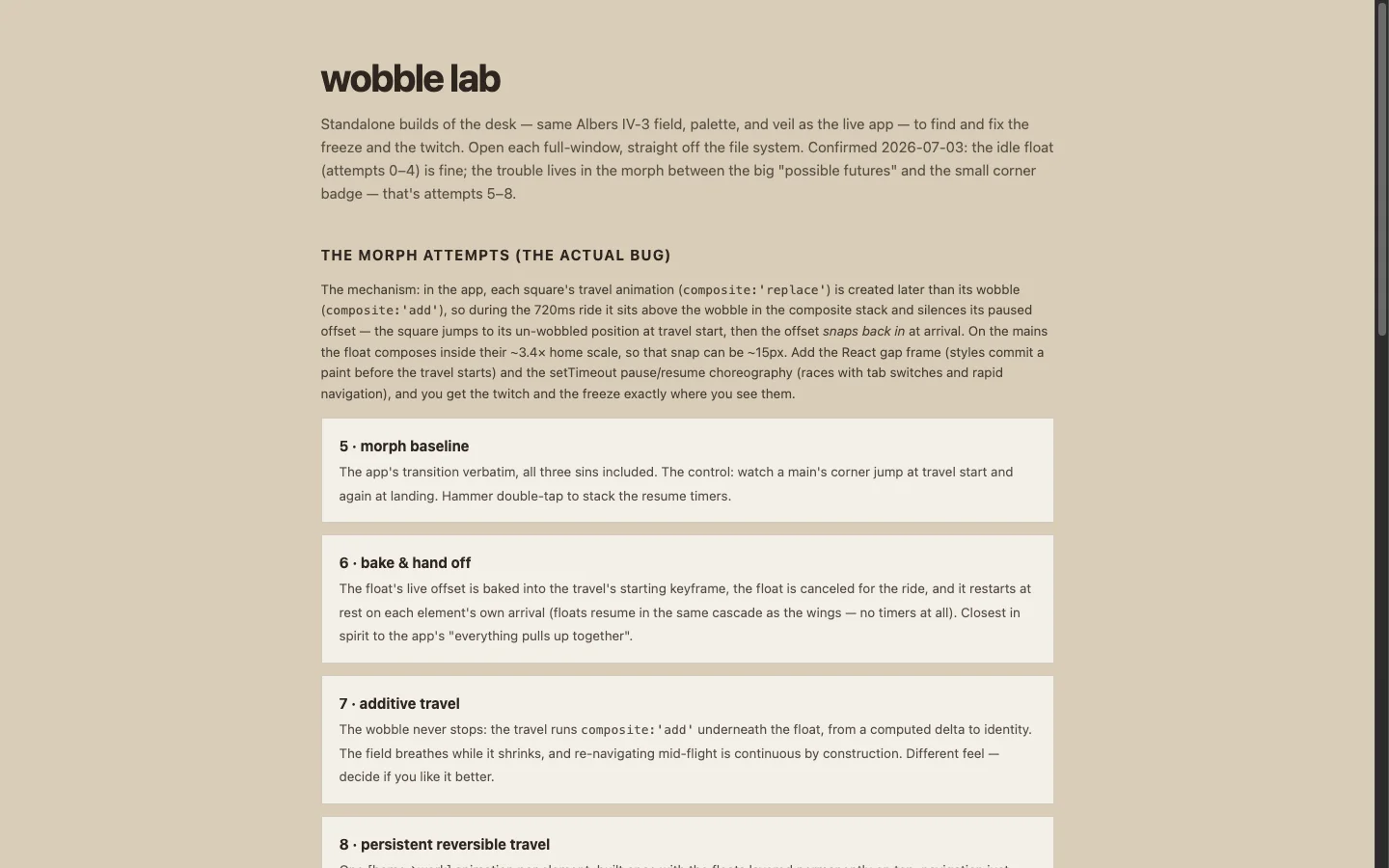
And on the development side, when the desk's idle animation twitched, the lab isolated it to the browser's compositor. A travel animation created above a float silences the float's offset, and a blend mode cannot leave the element it moves with. The fix runs the travel additively beneath the float.
The wobble lab. A standalone page with its own viewing protocol, built to isolate one compositor bug — and still runnable.
06Accessible by settings
Under 26px is reading text, and it scales.
A friend with a large phone font could not read the app. That turned into a full round: a text size setting wired through every reading size in the app, layouts that stack when type grows, legibility sliders that keep separate settings for light and dark after a night-time adjustment greyed out the daylight paper, and anchor jumps that respect reduced motion. The rule that fell out of the audit was simple: under 26 pixels is reading text and scales; 26 and up is display and holds still.
Text size · Normal
The same frame at Normal.
Text size · Larger
At Larger, reading text scales and the layout stacks; display type holds still.
07An H2 seed
The tool, on its own map.
I don't know where this is going in terms of how work and hiring evolve in the age of artificial intelligence.
What I know is that the "job search" needs a rehaul. The current system leaves people flailing, sending hundreds or thousands of resumes into an abyss, and asks them to become more machine-like to survive it. That system is Horizon 1, and it is declining. Somewhere out there is a Horizon 3 where hiring works differently. This tool is trying to be a Horizon 2 seed: a bridge to change, built small and personal, that points at a different way without knowing how it will all play out.
Which means the tool is judged by the same framework it teaches. The intake asks you to sort your own work into what is fading, what bridges, and what is worth growing toward. Possible Futures, honestly sorted, sits in the middle column.
For now, it runs in three ways: hosted, in private preview with funded spots for those who would feel the difference most, and a desktop app in progress. Job seekers are half of the job market; if enough of us tend our own compasses, together we might start to see how work is changing and shape new norms rather than inherit the old ones.
Three Horizons. The framework the tool teaches — and where the tool itself sits, honestly sorted, on the H2 curve.